
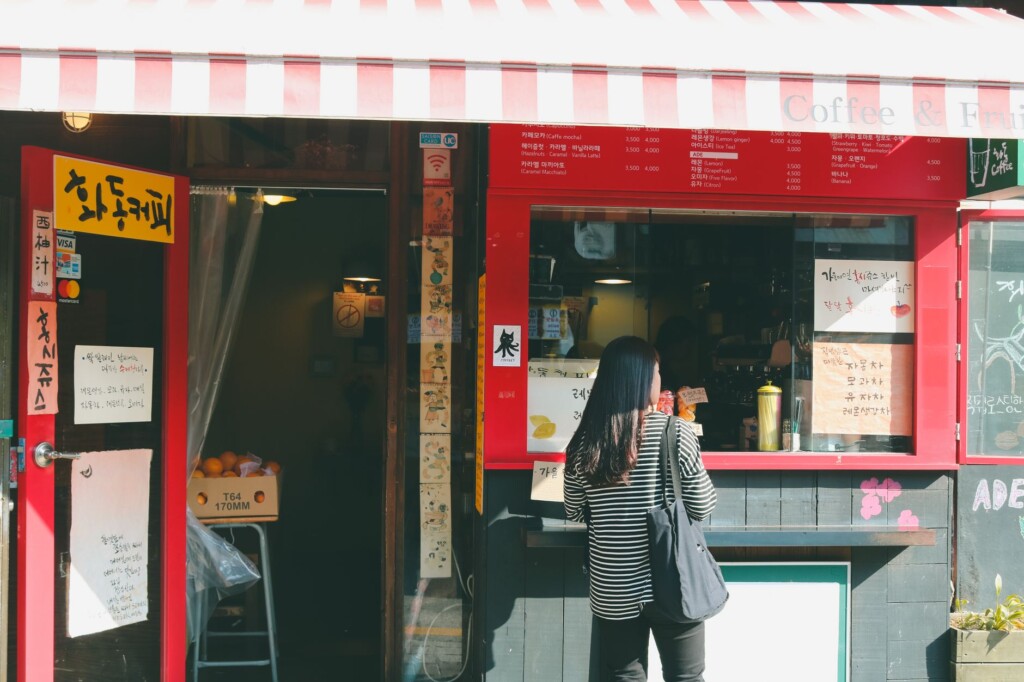
Your flashcards know 500 words. Why can’t you order lunch?

You open your flashcard app and crush your daily review. 500 words, maybe more. You know 밥 (bap, rice), 주문 (jumun, order), 계산 (gyesan, payment). Then you walk into a 김밥 shop, the staff member looks at you, and your brain goes completely blank. You point. You say 이거 (igeo, this one) and hope for the best.
If that’s you, nothing is wrong with your memory. The problem is that when you study Korean online with flashcards alone, you’re training one skill (recognition) and expecting a totally different one (production) to show up for free. It doesn’t work like that.
Recognition and recall are different muscles
A flashcard shows you 주문 and you think “oh, order.” That’s recognition. It’s easy because the word is sitting right in front of you doing half the work.
Ordering lunch is the reverse. You start with the idea in your head (“I’d like one bibimbap”) and you have to build the Korean from nothing, in real time, while someone waits. No prompt. No four multiple-choice options. That’s recall, and it’s a much harder lift.
Here’s the uncomfortable part. You can have 95% recognition and near-zero recall on the same 500 words. Your app only ever tests the easy direction, so it tells you you’re ready when you’re not.
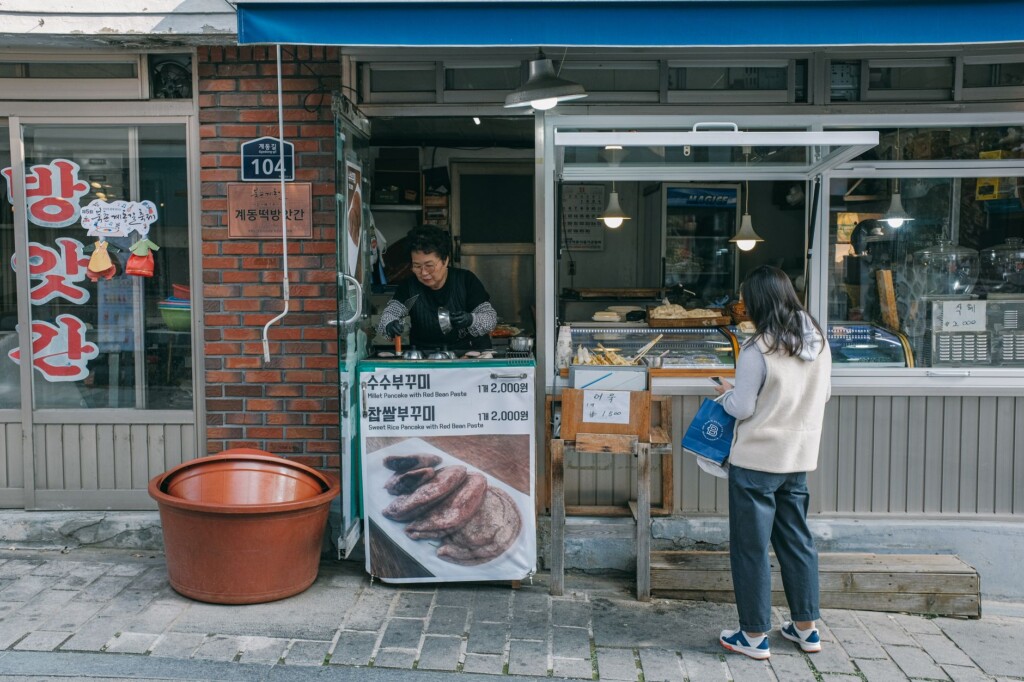
Flashcards drop the glue between words
Real sentences aren’t just nouns stacked together. They’re held together by particles, endings, and little connectors that flashcards almost never drill.
Say you want “one bibimbap, please.” You know 비빔밥. You know 하나 (hana, one). But the natural line is 비빔밥 하나 주세요 (bibimbap hana juseyo), and 주세요 (juseyo, please give me) is the glue that makes it an actual order instead of two floating words. Nobody says it on a flashcard, so you never practiced it.
Natural korean usage lives in these chunks:
- 주세요 (juseyo) “please give me” the single most useful ordering word there is
- 이거 주세요 (igeo juseyo) “this one, please” point and say it, works every time
- 저기요 (jeogiyo) “excuse me” how you actually get staff attention
- 얼마예요? (eolmayeyo) “how much is it?”
- 포장이요 (pojangiyo) “to go / takeout”
Memorize those five chunks as whole units and you can handle most counters in Korea. That’s maybe twenty minutes of work, and it beats another 500 isolated nouns you can’t deploy.
The missing ingredient is speed under pressure
At a lunch counter you have roughly two seconds before the silence gets awkward. Knowing a word in four seconds feels fine when you’re studying on the couch. It’s useless when someone’s waiting and three people are lining up behind you.
Speaking confidence isn’t a personality trait you either have or don’t. It’s mostly the result of having said a phrase out loud so many times that it comes out without a search. You’re not translating anymore. You’re just reaching for a thing that’s already there.
So the fix is boring and it works: say your target phrases aloud, over and over, until they stop feeling like a test.
Practice the whole transaction, not single words
Flashcards give you ingredients. A meal needs the recipe. Rehearse the actual sequence you’ll use:
- 저기요 (get attention)
- 비빔밥 하나 주세요 (order)
- 얼마예요? (ask the price)
- 카드 되나요? (kadeu doenayo, can I pay by card?)
- 감사합니다 (gamsahamnida, thank you)
Run that five-line script out loud ten times. Now you have a lunch order that lives in your mouth, not just your app. When the moment comes, you’re following a path you’ve already walked.
Make your study match real life
You don’t have to throw out your flashcards. They’re good at what they do. The trick is to add the part they skip.
Try this when you study Korean online this week:
- Flip the direction. Cover the Korean side and produce it from the English meaning. If you can’t say it out loud, you don’t know it yet.
- Learn phrases, not just words. Save 물 주세요 (mul juseyo, water please) as one card, not 물 and 주세요 separately.
- Shadow real audio. Find a short clip of someone ordering or chatting, then repeat it out loud copying their rhythm. This is where natural korean usage sticks.
- Talk to a real person. A tutor, a language exchange partner, anyone who’ll answer back. Recall only grows when something unpredictable comes at you.
One honest check
Before your next review session, do this: set a 10 second timer and say, out loud, how you’d order your favourite dish in Korean. Full sentence. If you hit it before the timer, great. If you froze, that’s your real study list, and it’s a lot shorter than 500 words.
The gap between knowing and speaking is normal. Close it on purpose and you’ll order that lunch 주문 (order) without a single blank stare.
Practice What You Learned
Try these interactive quizzes related to this topic:










Responses