
Korean Christmas: Holiday Vocabulary

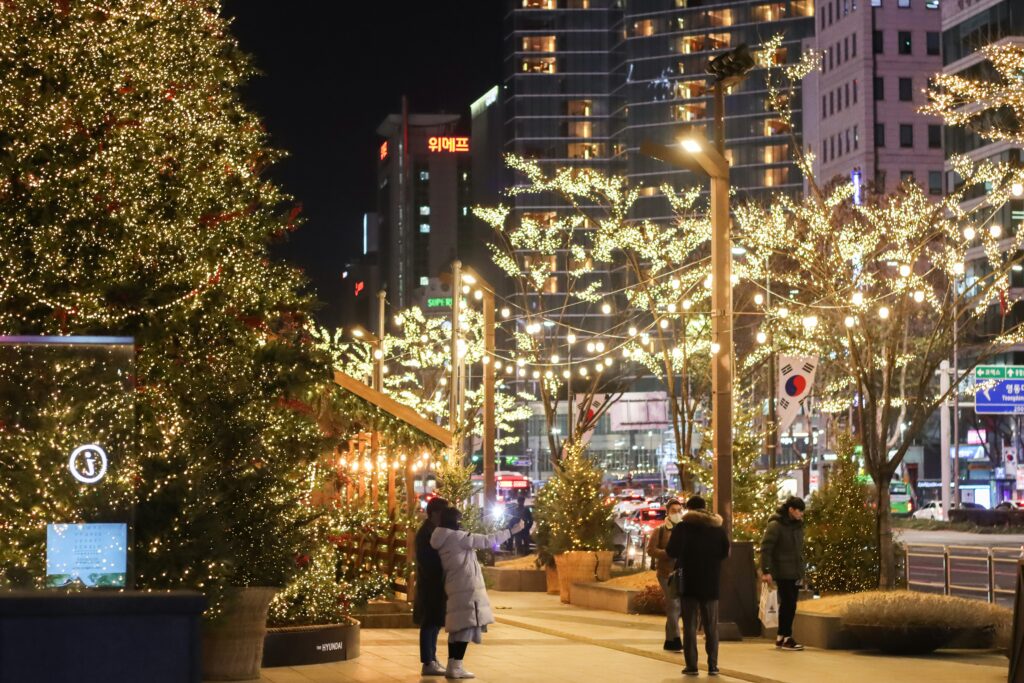
As winter settles over Korea and twinkling lights begin to appear in every neighborhood, there’s a magical transformation happening. Streets in Seoul, Busan, and cities across the country burst into brilliant displays of illumination, cafés roll out special holiday menus, and the air fills with the sound of Christmas carols—both in English and Korean. Whether you’re planning to spend the holidays in Korea or simply want to share festive greetings with Korean friends, mastering Christmas vocabulary will help you fully embrace the holiday spirit the Korean way.
Let’s unwrap the essential Korean Christmas vocabulary you’ll need to celebrate like a local!

Essential Christmas Greetings and Phrases
The heart of any celebration lies in the greetings we share. Korean Christmas greetings blend traditional Korean politeness with festive cheer, creating warm expressions that resonate throughout the holiday season.
메리 크리스마스 (meri keuriseumaseu) – Merry Christmas
This is the most common way to wish someone a Merry Christmas in Korea. It’s a direct borrowing from English, written in Hangul. You’ll see this phrase everywhere during December, from shop windows to greeting cards.
즐거운 성탄절 되세요 (jeulgeoun seongtanjeol doeseyo) – Have a joyful Christmas
This is a more traditional Korean expression using native vocabulary. 성탄절 (seongtanjeol) is the Korean word for Christmas, literally meaning “holy birth day.”
행복한 연말 되세요 (haengbokhan yeonmal doeseyo) – Have a happy end of the year
Since Christmas and New Year’s are so close together, Koreans often extend their greetings to encompass the entire year-end period.
새해 복 많이 받으세요 (saehae bok mani badeuseyo) – Receive lots of blessings in the New Year
While not exclusively a Christmas greeting, you’ll hear this constantly in late December as people prepare for the new year.
Cultural note: In Korea, Christmas is recognized as a national holiday, but it’s celebrated quite differently than in Western countries. It’s traditionally viewed as a romantic holiday for couples, similar to Valentine’s Day, though families with young children have increasingly adopted more Western-style celebrations with gift-giving and family gatherings.
Christmas Decorations and Symbols
Korean cities transform into winter wonderlands each December, with decorations that blend Western Christmas traditions with Korean aesthetic sensibilities. Understanding these terms will help you describe the beautiful scenes around you.
크리스마스 트리 (keuriseumaseu teuri) – Christmas tree
Christmas trees are everywhere in Korea during December, from massive displays in department stores to small tabletop versions in cafés. Many Korean families decorate trees in their homes, especially those with children.
장식 (jangsik) – Decoration/ornament
This general term covers all types of decorations. You might hear: “크리스마스 장식이 예뻐요” (keuriseumaseu jangsigi yeppeoyo) – “The Christmas decorations are pretty.”
전구 (jeongu) or 조명 (jomyeong) – Lights/illumination
Korean cities are famous for their spectacular Christmas light displays. Areas like Cheonggyecheon Stream in Seoul and Gwangalli Beach in Busan host incredible illumination festivals.
눈사람 (nunsaram) – Snowman
While Korea does get snow in winter, it’s not as reliable as you might think. Still, snowman decorations are popular, and when it does snow, you’ll see real ones pop up in parks.
산타클로스 (santakeulloseu) or 산타 할아버지 (santa harabeoji) – Santa Claus
The second term literally means “Santa grandfather,” a charming Korean twist on the jolly gift-giver.
루돌프 (rudolpeu) – Rudolph
The red-nosed reindeer is just as popular in Korea as elsewhere, often appearing in decorations and children’s songs.
선물 (seonmul) – Gift/present
Gift-giving is an important part of Korean culture year-round, and Christmas is no exception. Department stores create elaborate gift sets specifically for the holiday season.
Christmas Foods and Treats
Korean Christmas celebrations feature a delightful mix of traditional Korean foods and Western-inspired treats. Food is central to Korean culture, and the holidays are no exception.
크리스마스 케이크 (keuriseumaseu keikeu) – Christmas cake
Christmas cakes in Korea are serious business. Bakeries compete to create the most beautiful and delicious cakes, often featuring fresh strawberries, whipped cream, and elaborate decorations. Ordering your cake in advance is essential!
치킨 (chikin) – Fried chicken
Here’s a uniquely Korean tradition: eating fried chicken on Christmas! This tradition has become so popular that chicken restaurants require advance orders for Christmas Eve and Day. It’s Korea’s answer to Western Christmas turkey or ham.
와인 (wain) – Wine
Wine consumption increases dramatically during the Christmas season in Korea, with special holiday bottles and gift sets appearing in stores.
핫초코 (hatchoko) or 핫초콜릿 (hatchokollit) – Hot chocolate
Cafés across Korea serve special Christmas versions of hot chocolate, often topped with marshmallows and festive sprinkles.
진저브레드 (jinjeobeureddeu) – Gingerbread
While not traditionally Korean, gingerbread cookies and houses have become increasingly popular, especially in Western-style cafés and bakeries.
과자 (gwaja) – Cookies/sweets
Christmas-themed cookies and candies fill store shelves throughout December. Many Korean families have adopted the tradition of baking Christmas cookies together.
If you’re learning Korean and want to practice discussing food, holiday vocabulary, or cultural traditions, interactive learning methods can make all the difference. Platforms like uBitto for learners offer contextual learning that helps you understand not just the words, but how they’re used in real-life situations like ordering at a Christmas market or chatting with friends about holiday plans.
Christmas Activities and Events
Korea offers countless ways to celebrate the season, from romantic couple activities to family-friendly events. Knowing these terms will help you navigate and discuss holiday plans.
데이트 (deiteu) – Date
As mentioned earlier, Christmas in Korea is primarily seen as a romantic holiday. Young couples plan elaborate dates, and restaurants and hotels offer special Christmas packages.
일루미네이션 (illumineisyeon) or 빛 축제 (bit chukje) – Illumination festival/light festival
Major cities host spectacular light festivals throughout December and into January. These are must-see events that draw huge crowds.
캐롤 (kaerol) – Carol
Christmas carols echo through shopping districts, with both English classics and Korean versions being performed by street musicians and in stores.
미사 (misa) or 예배 (yebae) – Mass/church service
For Korea’s Christian population (about 30% of the country), attending Christmas Eve or Christmas Day services is an important tradition.
파티 (pati) – Party
Christmas parties are popular among friends, coworkers, and social groups. You might be invited to an “송년회” (songnyeonhoe), or year-end party, which often incorporates Christmas themes.
쇼핑 (syoping) – Shopping
Christmas shopping is a major activity, with stores offering sales and special promotions throughout December.
자선활동 (jaseon hwaldong) – Charity activities
Many organizations and individuals participate in charitable giving during the holiday season, following the spirit of Christmas generosity.
Romantic Christmas Expressions
Since Christmas in Korea has a distinctly romantic flavor, it’s useful to know some expressions related to couples and romance during the holiday season.
커플 (keopeul) – Couple
You’ll see couples everywhere on Christmas Eve and Day, often wearing matching outfits called 커플룩 (keopulluk).
화이트 크리스마스 (hwaiteu keuriseumaseu) – White Christmas
A snowy Christmas is considered especially romantic in Korea, though Seoul doesn’t always cooperate with snow on Christmas Day.
고백 (gobaek) – Confession (of feelings)
Christmas is considered an auspicious time to confess romantic feelings, similar to Valentine’s Day.
프러포즈 (peureopozu) – Proposal
Many Korean couples get engaged during the Christmas season, with romantic proposal events taking place at illumination festivals and special holiday venues.
로맨틱 (romaentik) – Romantic
This borrowed word is used extensively during Christmas season to describe everything from restaurant atmospheres to date ideas.
For educators teaching Korean language and culture, the Christmas season offers rich material for lessons about modern Korean society and how Western holidays have been adapted to fit Korean cultural values. Resources like uBitto for educators can help create engaging, culturally-relevant lesson plans that connect language learning with real-world contexts.
Bringing It All Together
Understanding Korean Christmas vocabulary opens up more than just the ability to read signs or order seasonal treats—it provides insight into how Korean culture blends global influences with local traditions. The way Koreans celebrate Christmas, mixing romantic couple culture with emerging family traditions, reflects the country’s unique position as a bridge between East and West.
Here are some practical sentences combining the vocabulary you’ve learned:
- 크리스마스에 여자친구랑 데이트할 거예요. (keuriseumaseu-e yeojachingurang deiteuhalgeoye-yo) – I’m going to date my girlfriend on Christmas.
- 명동에서 크리스마스 장식을 보러 갈래요? (myeongdong-eseo keuriseumaseu jangsigeul boreo gallaeyo?) – Do you want to go see the Christmas decorations in Myeongdong?
- 치킨이랑 케이크를 주문했어요. (chikin-irang keikeureul jumunhaesseoyo) – I ordered chicken and cake.
- 올해는 화이트 크리스마스가 되면 좋겠어요. (olhaeneun hwaiteu keuriseumaseu-ga doemyeon jokesseoyo) – I hope we have a white Christmas this year.
As you explore Korean Christmas culture and vocabulary, remember that language learning is most effective when it’s connected to real experiences and cultural understanding. Whether you’re planning to visit Korea during the holidays, connecting with Korean friends, or simply expanding your language skills, this seasonal vocabulary will serve you well.
The beauty of learning Korean through cultural contexts like holidays is that it makes the language come alive. You’re not just memorizing words—you’re gaining the ability to participate in celebrations, understand social customs, and connect with people during meaningful times of year.
Ready to take your Korean learning to the next level? Whether you’re a self-directed learner looking for structured programs or an organization seeking to provide Korean language education, uBitto offers AI-powered solutions that adapt to your needs. From comprehensive learning programs to resources for corporate training, there are tools available to help you master Korean in a way that fits your goals and lifestyle.
This Christmas season, challenge yourself to use these Korean phrases and vocabulary in real situations. Send a Korean Christmas greeting to a friend, order a 크리스마스 케이크 at a Korean bakery, or simply enjoy Korean Christmas music while practicing your pronunciation. Each small step builds your confidence and brings you closer to fluency.
메리 크리스마스! 즐거운 성탄절 되세요! May your holidays be filled with joy, delicious food, beautiful illuminations, and meaningful connections—all enhanced by your growing Korean language abilities. Happy learning, and happy holidays!
Practice What You Learned
Try these interactive quizzes related to this topic:
[UBQ id = “66”]
[UBQ id = “186”]













Responses